Dance Around the World - The 9 Classical Dance Forms of India
You've probably heard that India has over a hundred different languages, but did you know some of these languages each have a different style of dance?
Today we're going to explore the 9 main Classical forms of India: Kathak, Manipuri, Odissi, Kuchipudi, Bharatanatyam, Kathakali, Mohiniyattam, Sattriya, and Chau.
Kathak

Kathak originated in North India and it is known for its precise footwork, graceful gestures, and storytelling. The word Kathak is derived from the Sanskrit word "Katha" which means story, hence the storytelling aspect of the Kathak dance form. Many Kathak songs and dances are in the languages Hindi or Sanskrit because of Kathak's origin of North India.
Manipuri

Manipuri originated in a northeastern state in India called Manipur. Manipuri is a devotional dance form that is performed at festivals and rituals and many times it portrays stories about the Hindu god Krishna. Manipuri is often compared to the flowing of the Yamuna river because of its graceful unbroken movements.
Odissi

Odissi originated in the temples of Odisha, which is located in the eastern part of India. Odissi is known for it's graceful, flowy movements and for its emotive facial expressions. Odissi is based off of Jaidev's Gita Govindam, a poetic work from the12th century. This dance form is mostly performed by women and devoted to Lord Vishnu, one of the Hindu gods.
Kuchipudi

Kuchipudi originated from the state Andhra Pradesh. Andhra Pradesh is a Telugu speaking state, so Kuchipudi has some songs in the language Telugu while also having some songs in other languages including Sanskrit. Kuchipudi has a blend of pure dance and drama but it is known for its storytelling and many ballets including Bhamakalapam and Golla Kalapam.
Bharatanatyam

Bharatanatyam originated mainly from areas in Tamilnadu, hence the Tamil language in many of its songs, and is thought to be over 2000 years old. When it was first developed this dance form was known as Dasiattam, "dance of the servants of god," it later became known as Bharatanatyam which is known for its pure dance and for its storytelling aspect.
Kathakali

Kathakali is thought to have originated in Kerala, which is located in Southwestern India, in the 17th century. Kathakali is a deeply religious and devotional dance form that is performed at many religious rituals and festivals. Kathakali is derived from the word "Katha" which means story and "Kali" which means play, so Kathakali is very drama oriented.
Mohiniyattam

Mohiniyattam is made up of very graceful movements and based on the Lasya style, which is a very feminine, graceful style. Unlike many of the other Indian dance forms, Mohiniyattam does not have any sudden jerks or leaps. Mohiniyattam literally means "The dance of Mohini" who is a Hindu goddess. This dance form originated from Kerala and it is performed as a solo dance.
Sattriya

Sattriya was first introduced in the 15th century. When this dance form was made, many different elements including local folk dances were incorporated into it, leading to a mix of both pure dance and graceful movements. Sattriya is also known for its many hand gestures, specific footwork and rhythmic syllables.
Chau
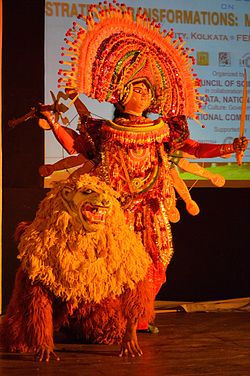
Chau is considered to be a semi-classical dance form of India. Some people consider it to be one of India's classical dances while others do not. Chau is found in 3 different styles, each from a different region in India: the Purulia Chau from West Bengal, the Seraikella Chau from Jharkhand and the Mayurbhanj Chau of Odisha. Chau is a mix of martial arts, acrobatics, and folk dance and it is based off of religious Hindu themes.
Sources
https://www.ipassio.com/wiki/dance/indian-classical-dance/odissi
https://www.utsavpedia.com/cultural-connections/the-spell-bounding-dance-mohiniyattam/
Indian Classical Dances Kuchipudi Coarse Material 2, SAMPADA, SiliconAndhra Publications
https://www.keralatourism.org/artforms/kathakali-kerala-theatre/15/


